
You’ve followed tutorials, finished personal projects, maybe even shipped a small app or two. But you still haven’t been paid by a real client.That gap between “I can code” and “someone paid me to code” feels huge when you’re standing on the wrong side of it. Most beginners assume the missing piece is more skills, more projects, or a computer science degree. It isn’t.The missing piece is usually a clear plan for getting in front of the right clients — and making it easy for them to say yes.This guide walks through exactly how beginners land their first paid freelance coding client in 2026, even with zero prior freelance experience and nothing paid in their portfolio yet.
—## Why Most Beginners Stay Stuck
The biggest mistake new freelancers make is waiting until they feel “ready.”They keep adding projects to their portfolio. They keep learning new frameworks. They keep telling themselves they’ll start applying once they’ve picked up one more skill.Meanwhile, other people with fewer technical skills — but better positioning — are already getting paid.Here’s the truth most people won’t tell you: clients aren’t hiring the best developer available. They’re hiring the person who makes a specific problem disappear with the least amount of their own time and stress.Once you understand that, everything about how you present yourself changes.
## What Clients Actually Pay For
A small business owner doesn’t want “a Python script.” They want their weekly inventory report to stop eating three hours of copy-pasting.A startup founder doesn’t want “a landing page.” They want to start collecting email addresses before launch day.Every job post is really a description of a problem. Your job is to show that you can solve that specific problem.This is why beginners with a narrow, clear offer often beat more experienced generalists. A client scanning 40 proposals doesn’t need the 40th-best developer in the world — they need the clearest, most relevant, most trustworthy-sounding proposal out of those 40.That’s a solvable problem.
## Step 1: Get Your Portfolio Client-Ready
Before you send a single proposal, you need 2–3 projects that look like paid work — not tutorial clones. If you haven’t sorted that yet, we cover exactly how to build one from scratch, even with zero clients, here.
The short version: pick a real problem, solve it as if a client hired you, and frame the result in plain English — outcome first, tech stack second. Do that, and you’re ready for the next step.
## Step 2: Choose a Narrow Starting Service
“I can build anything” is one of the weakest pitches a beginner freelancer can make.Clients don’t hire unknown generalists. They hire people who look like specialists in their exact problem.Some strong starting niches for beginner freelance developers:- Small business automation (spreadsheet and email tasks)- Landing pages for product launches- Simple API integrations- Web scraping and data collection- Taking local projects live on a real domainPick one. Write a single clear sentence describing what you do:”I help [type of client] [achieve outcome] by [what you actually build].”Example: “I help small online stores stop losing sales to slow websites by rebuilding and deploying faster, mobile-friendly storefronts.”You can change your niche later. The goal right now is to make your first ten proposals dramatically more effective.
## Step 3: Set Up Profiles That Convert
You need profiles on the platforms where clients are already looking for developers. For most beginners in 2026, that still means Upwork and Fiverr.On **Upwork**, your profile supports your proposals — clients usually read the proposal first, then check the profile. On **Fiverr**, the gig title and thumbnail do most of the work. A weak title like “I will code python scripts” gets ignored. A strong one speaks to the outcome: “I will build a custom Python automation script to save you hours every week.”Both platforms reward fast response times. Turn on notifications and reply within a few hours during your first weeks — early momentum compounds.Before you send a single proposal, make sure your profile has:- A real, friendly photo- A fully completed profile (platforms flag incomplete ones)- Verified identity- A short list of relevant skills (five strong ones beat twenty vague ones)
## Step 4: Write Proposals That Actually Get Read
Most freelance proposals are generic, obviously copy-pasted, and all about the freelancer. That’s a low bar to clear.A proposal that references the actual job in the client’s own language stands out immediately.**A simple four-part structure that works:**
1. Open by naming their specific problem in your own words
2. Briefly state how you’d approach it (one or two concrete sentences)
3. Point to the one most relevant portfolio piece
4. End with a low-friction next step — a question or a short callKeep it under 150 words. Clarity beats length.Expect to send 10–20 tailored proposals before landing your first job. That’s normal, not a sign something’s wrong with your approach.
## Step5. Price Without Freezing
Pricing is where most beginners freeze.A realistic starting range for a beginner freelance developer in 2026 is roughly $15–$30 per hour, or the local equivalent. Charging $5/hour to “compete” usually attracts the worst clients and signals low quality rather than good value.For fixed-price work, estimate your hours honestly, multiply by your hourly rate, then add 20–30% as a buffer for the inevitable clarifying questions and small revisions.Never quote a number before you understand the scope. A quick “probably around $100” sent too early almost always turns out too low once the real requirements appear.
## The Real Advantage Beginners Have
Many small clients — solo founders, local businesses, non-technical entrepreneurs — actually prefer working with newer freelancers. Newer freelancers tend to be more responsive, more affordable, and more willing to explain things in plain English than agencies or highly experienced developers.You don’t need to be the best coder in the room. You need to be the clearest and most relevant person in the proposal list.## FAQ**How long does it take to land your first freelance coding client?**Most beginners land their first client after 10–20 tailored proposals, which for a consistent applicant usually means somewhere between two and six weeks.**Do I need a computer science degree to freelance as a developer?**No. Clients care about whether you can solve their specific problem, not your credentials. A focused portfolio matters far more than a degree.**What should a beginner freelance developer charge per hour?**A realistic starting range in 2026 is roughly $15–$30 per hour, depending on your niche and location. Pricing too low tends to attract lower-quality clients.
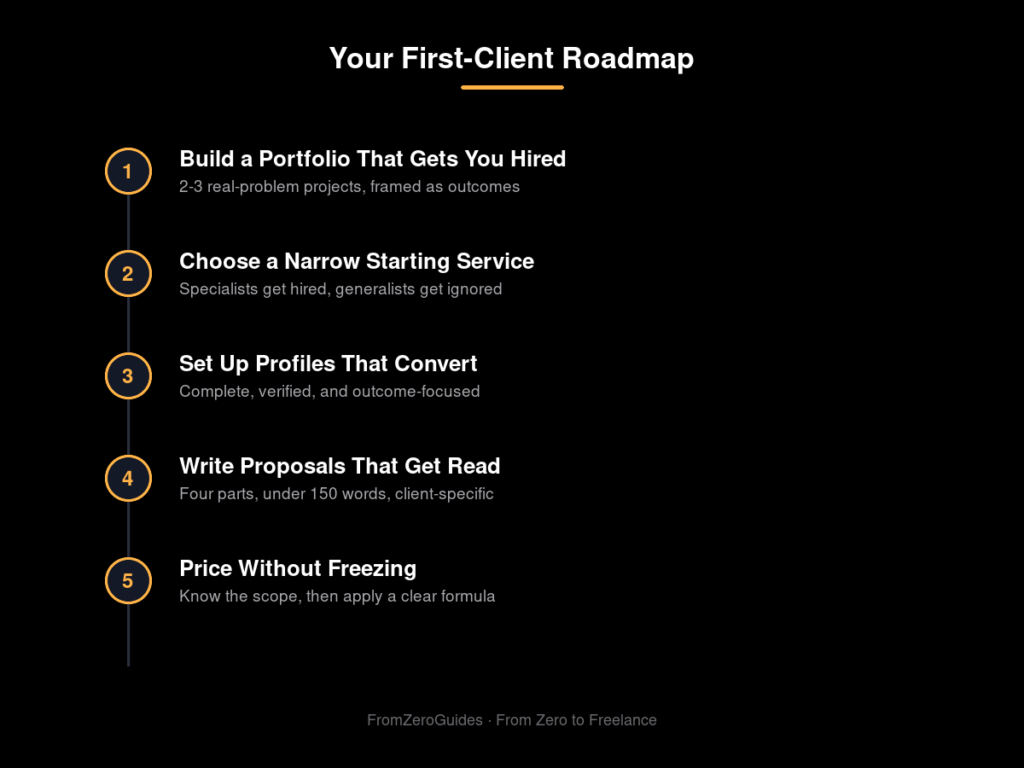
## What to Do NextYou now have the overall map:
1. Get your portfolio client-ready (see our full portfolio guide if you haven’t yet)
2. Choose one narrow starting service
3. Set up complete profiles on Upwork and Fiverr
4. Start sending tailored proposals
5. Price with a clear framework instead of guessing. The full *From Zero to Freelance* guide goes much deeper on every one of these steps — the exact proposal structure, pricing formulas, discovery call questions, portfolio case-study templates, and the step-by-step plan for landing your first client and then the next ten.If you’re ready to stop waiting for permission and start getting paid for the skills you already have, the complete guide is here.
You don’t need more experience. You need a clear system and the willingness to send the first proposal.Start there.